 today deals
 special offer


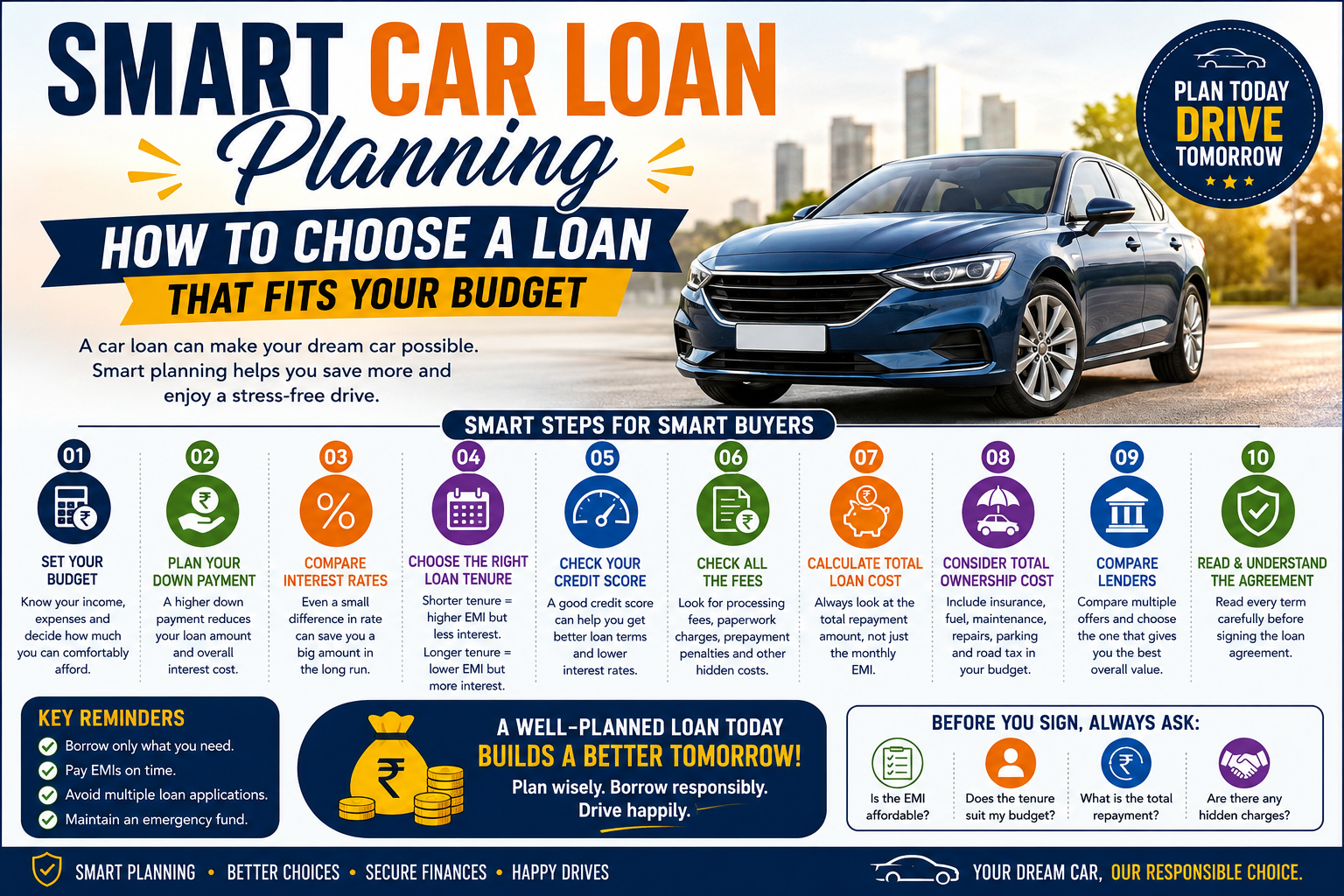
Smart Car Loan Planning: How to Choose a Loan That Fits Your Budget
[ez-toc]
Buying a car is an important financial decision. For many buyers, paying the entire purchase price from savings is not practical, so a car loan can make the purchase more manageable by spreading the cost over a period of time.
However, getting approved for a car loan does not necessarily mean the loan is affordable for you.
A car loan affects your monthly budget for several years, and the actual cost of owning a car includes much more than the monthly loan payment. Insurance, fuel, maintenance, registration, parking, repairs, and other expenses can all add to the cost of ownership.
That is why smart car loan planning should begin before you visit a lender or submit a loan application.
The goal is not simply to find the largest loan you qualify for. Instead, it is to understand how much you can comfortably afford, compare the total cost of different loan options, and choose repayment terms that fit your financial situation.
In this guide, we will explain the important factors to consider when planning a car loan and how to avoid common mistakes.
What Is a Car Loan?
A car loan is a type of financing used to purchase a vehicle. The lender provides money toward the purchase, and the borrower repays the amount according to agreed terms.
The repayment usually includes the amount borrowed plus interest and any applicable charges.
The exact terms can vary between lenders and borrowers. Factors such as the vehicle, loan amount, repayment period, credit history, income, and lender requirements may influence the available offer.
Before accepting any loan, it is important to read the agreement carefully rather than focusing only on the advertised interest rate or monthly EMI.
1. Start With Your Total Car Budget
The first step in car loan planning is deciding how much you can realistically spend on the entire car purchase.
Do not begin by asking, “How much loan can I get?”
Instead, ask, “How much can I comfortably spend on a car without putting unnecessary pressure on my finances?”
Your budget should consider:
- Car purchase price
- Down payment
- Loan repayment
- Insurance
- Fuel or charging costs
- Routine servicing
- Repairs
- Registration and related expenses
- Parking
- Emergency expenses
A car that looks affordable based on its EMI alone may become expensive once all ownership costs are included.
For example, two cars could have similar monthly loan payments but very different fuel, maintenance, insurance, and repair costs.
Looking at the complete ownership budget can therefore provide a more realistic picture.
2. Decide How Much You Can Pay as a Down Payment
A down payment is the amount you pay toward the vehicle from your own funds rather than borrowing the entire purchase amount.
A larger down payment can reduce the amount you need to borrow.
For example, suppose a vehicle costs ₹10 lakh and you make a ₹2 lakh down payment. The amount financed would be lower than if you borrowed nearly the entire purchase price.
However, using all your savings for a down payment may not be a good idea either.
You should avoid leaving yourself without sufficient funds for emergencies and other important financial needs.
The right down payment depends on your income, savings, existing obligations, and overall financial situation.
The goal should be to balance a manageable loan with enough financial reserves.
3. Understand How EMI Works
EMI stands for Equated Monthly Instalment.
It is the scheduled amount paid toward a loan each month under a standard EMI-based repayment structure.
An EMI generally consists of both principal and interest components.
The exact EMI depends on factors such as:
- Loan amount
- Interest rate
- Repayment period
A longer repayment period can reduce the monthly EMI, but it may increase the total interest paid over the life of the loan.
A shorter repayment period may result in a higher monthly payment but can reduce the overall interest cost, assuming the interest rate and other terms remain comparable.
This is why looking only at the EMI can be misleading.
Before choosing a loan, consider both the monthly payment and the total amount you will repay.
4. Compare Interest Rates Carefully
The interest rate is one of the most important parts of a car loan.
A lower rate can reduce the cost of borrowing, but borrowers should not compare rates without looking at the complete loan terms.
Ask whether the advertised rate applies to your specific situation and whether there are additional charges.
When comparing offers, look at:
- Interest rate
- Loan amount
- Repayment period
- Processing charges
- Documentation charges
- Prepayment or foreclosure conditions
- Other applicable fees
Do not assume that the lender advertising the lowest headline rate will always provide the lowest overall borrowing cost.
The actual offer available to you may differ from the promotional rate.
5. Choose a Loan Tenure That Fits Your Finances
Loan tenure refers to the length of time over which you repay the loan.
A shorter tenure generally means higher monthly payments but fewer months of repayment.
A longer tenure can make monthly payments easier to manage, but it may increase the total interest cost.
For this reason, the longest available tenure is not automatically the best option.
Consider your income stability, existing financial commitments, expected expenses, and ability to handle the monthly payment.
A repayment period should be long enough to keep the EMI manageable but not unnecessarily long if a shorter period is comfortably affordable.
6. Check Your Credit Profile Before Applying
Your credit history can influence how lenders evaluate a loan application.
Before applying, review your credit report where available and check whether the information appears accurate.
Look for issues such as incorrectly reported accounts, outstanding balances, or other errors.
If you find inaccurate information, follow the appropriate process to request a correction.
It can also be useful to avoid making multiple unnecessary loan applications in a short period.
Most importantly, do not take steps simply to improve a credit score for one purchase if doing so creates financial problems elsewhere.
Credit health is better viewed as part of long-term financial management.
7. Don’t Ignore Loan Fees
Interest is not necessarily the only cost associated with a car loan.
Depending on the lender and loan arrangement, there may be additional charges.
Potential charges can include processing fees, documentation-related costs, late-payment charges, or other applicable fees.
The exact charges vary, so borrowers should check the lender’s current terms before accepting an offer.
Do not rely only on verbal explanations.
Ask for the complete cost information in writing and read the loan documents carefully.
This is particularly important when comparing two loans that appear similar based on their interest rates.
A slightly different fee structure can affect the total cost.
8. Calculate the Total Cost Before Signing
One of the most useful habits in car loan planning is calculating the approximate total repayment.
For example, if a monthly payment is ₹20,000 and the repayment period is 60 months, the scheduled payments alone would total ₹12 lakh.
That simple multiplication does not replace the lender’s official repayment schedule, and additional charges may apply, but it illustrates why borrowers should consider the total repayment rather than focusing only on the monthly figure.
Before signing, ask:
How much will I pay in total?
Also ask:
How much of that amount represents interest and other charges?
Understanding these figures can make it easier to compare different loan options.
9. Consider Your Other Monthly Commitments
A car loan does not exist separately from the rest of your financial life.
You may already have expenses such as rent, household costs, education expenses, insurance, existing EMIs, investments, and savings goals.
Adding a new EMI can reduce the amount available for emergencies or other priorities.
Before taking the loan, prepare a simple monthly budget.
List your regular income and essential expenses first.
Then consider the proposed car payment along with the expected cost of owning the vehicle.
If the budget looks too tight, consider a less expensive car, a larger down payment if financially appropriate, or postponing the purchase until your finances are more comfortable.
10. Think About the Full Cost of Car Ownership
The loan payment is only one part of the cost of owning a vehicle.
A realistic budget should include:
Fuel
Your monthly fuel cost can vary according to mileage, driving distance, fuel prices, traffic, and driving habits.
Insurance
Insurance is an ongoing ownership expense and should be included in your annual budget.
Maintenance
Regular servicing and replacement of consumable parts can add to the cost of ownership.
Repairs
Unexpected repairs can occur, particularly as a vehicle becomes older.
Parking and tolls
Depending on where you live and how you travel, parking and toll expenses can become significant.
When these costs are included, your actual monthly vehicle budget may be considerably higher than the EMI alone.
11. Compare Lenders Instead of Accepting the First Offer
It can be tempting to accept the first loan offer that appears convenient.
However, comparing multiple legitimate lenders can help you understand the range of available terms.
When comparing lenders, create a simple table containing:
| Factor | Lender A | Lender B | Lender C |
|---|---|---|---|
| Interest rate | Check offer | Check offer | Check offer |
| Loan amount | Check offer | Check offer | Check offer |
| Tenure | Check offer | Check offer | Check offer |
| Processing fee | Check offer | Check offer | Check offer |
| Prepayment terms | Check offer | Check offer | Check offer |
| Total repayment | Calculate | Calculate | Calculate |
The purpose is not to choose the lender with the biggest advertised number or the smallest headline rate.
The goal is to understand the complete cost and terms.
12. Read the Loan Agreement Carefully
Before signing, read the loan agreement and related documents.
Pay attention to:
- Interest calculation
- EMI amount
- Repayment schedule
- Loan tenure
- Processing charges
- Late-payment terms
- Prepayment conditions
- Foreclosure conditions
- Security or vehicle-related requirements
- Other applicable charges
If a clause is unclear, ask the lender for an explanation.
Do not sign a financial agreement simply because someone tells you that the terms are standard.
You should understand the important obligations before accepting the loan.
Common Car Loan Mistakes to Avoid
Choosing a car based only on EMI
A low EMI can sometimes result from a longer repayment period. Always consider total repayment.
Borrowing the maximum amount available
Being eligible for a larger loan does not mean you should borrow that amount.
Ignoring additional costs
Insurance, fuel, maintenance, and repairs can significantly increase the cost of owning a car.
Using all savings for the down payment
Keeping an appropriate emergency reserve can be important.
Focusing only on the interest rate
Fees and other terms can affect the total cost.
Skipping the loan documents
Never agree to terms you do not understand.
Taking a loan under financial pressure
If the EMI would make your monthly budget uncomfortable, reconsider the purchase rather than stretching your finances unnecessarily.
A Simple Car Loan Planning Example
Imagine you are considering a car priced at ₹9 lakh.
You decide to use ₹2 lakh as a down payment and finance the remaining ₹7 lakh.
Before accepting a loan, you could compare two hypothetical repayment options.
Option A: Shorter tenure with a higher monthly payment.
Option B: Longer tenure with a lower monthly payment.
Option B may look more comfortable each month, but the longer repayment period could result in a higher total interest cost.
The correct choice depends on your income, financial commitments, emergency savings, and ability to manage the payment.
This example is only for understanding the planning process. Actual interest rates, EMI amounts, fees, and loan terms vary by lender and borrower.
When Should You Consider Delaying a Car Purchase?
Sometimes the smartest car-loan decision is waiting.
You may want to reconsider the purchase if:
- You have very little emergency savings.
- Existing debt already consumes a large portion of your budget.
- Your income is uncertain.
- The proposed EMI would make essential expenses difficult to manage.
- You would need to borrow additional money for the down payment.
- You are choosing a more expensive car simply because a lender offers a larger loan.
A car can be useful, but it should not create unnecessary financial stress.
Frequently Asked Questions
Is a car loan a good idea?
A car loan can be useful when the monthly payment and total cost fit comfortably within your budget. Whether it is appropriate depends on your income, savings, existing obligations, vehicle cost, and loan terms.
Should I choose a shorter or longer car loan tenure?
A shorter tenure may increase the monthly payment but can reduce the number of months you pay interest. A longer tenure may lower the monthly payment but can increase the overall borrowing cost. Compare both the EMI and total repayment.
Is a bigger down payment always better?
Not necessarily. A larger down payment can reduce the amount borrowed, but using too much of your savings can leave you without enough money for emergencies. Your personal financial situation should guide the decision.
Does a lower EMI mean a cheaper car loan?
Not always. A lower EMI can result from a longer repayment period. Always compare the total repayment amount and applicable charges.
What should I check before accepting a car loan?
Review the interest rate, EMI, tenure, total repayment, processing fees, prepayment conditions, late-payment terms, and other applicable charges.
Can I compare more than one car loan?
Yes. Comparing legitimate loan offers can help you understand differences in rates, fees, tenure, and repayment costs.
Should I take the maximum car loan I am eligible for?
Not necessarily. Loan eligibility and affordability are different things. A responsible decision should be based on your complete monthly budget and long-term financial goals.
What is the most important car loan mistake to avoid?
One of the biggest mistakes is focusing only on the EMI while ignoring the total cost of borrowing and the other expenses associated with owning the vehicle.
Final Thoughts
Smart car loan planning is less about finding the biggest loan and more about finding a repayment plan that fits comfortably into your financial life.
Before applying, calculate your total car budget, consider the down payment, estimate the monthly payment, compare loan terms, review fees, and think about the full cost of vehicle ownership.
Most importantly, do not let an attractive EMI encourage you to buy a vehicle that is beyond your comfortable budget.
A car should support your lifestyle rather than create unnecessary financial pressure.
Take time to compare your options, read the loan documents carefully, and make the final decision based on your own financial circumstances.
Loan rates, fees, eligibility requirements, and terms can change, so always confirm the current details directly with the relevant lender before making a financial commitment.






Leave a Reply